
loading

Joy Inflatable - Custom Inflatable Tents for Events, Exhibitions, Commercial, Medical, Rescue and Sports Applications.        sale@joyinflatable.com

Customization & Project Solutions
13
How do I choose the right inflation system?

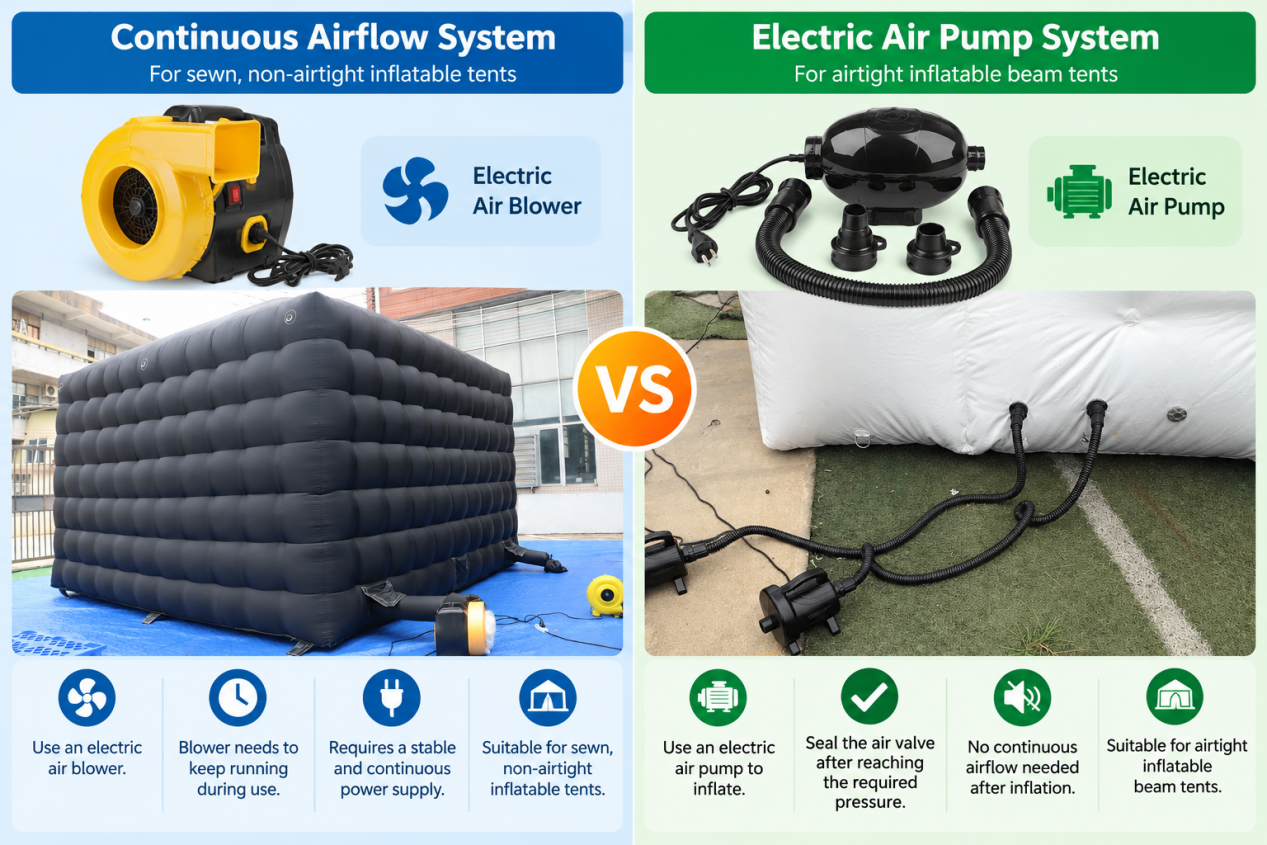
 Selecting the correct inflation system begins with the tent’s construction method, overall volume, material thickness, required setup speed, available electrical supply and any noise restrictions on site. Continuous-air (sewn) tents need a blower sized to replace air lost through fabric and seams, while airtight tents need a pump capable of reaching the design pressure efficiently and then being removed.

We evaluate these parameters together with the local voltage and frequency. Once the details are clear we specify compatible equipment—whether a continuous-duty blower or a high-pressure pump, so the system operates safely, quietly and efficiently in the intended location. Providing accurate site power information at the quotation stage ensures the delivered equipment matches local conditions from the first use.
14
Which tents can stay inflated without continuous airflow?

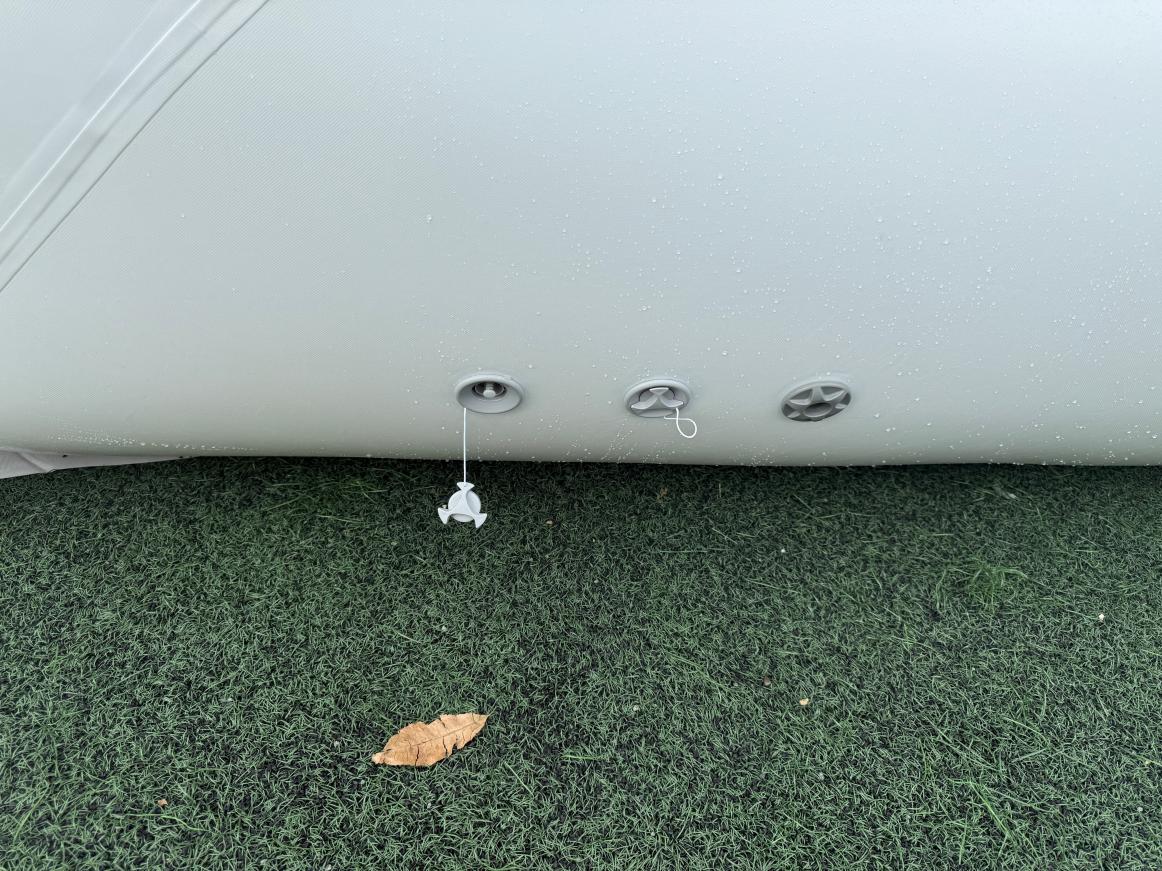
Only structures built with fully sealed, high-frequency welded airtight chambers are able to maintain their shape after the inflation device is removed. Once the valves are closed, internal pressure is retained by the integrity of the welded seams and the PVC material itself.

At Joy Inflatable, tents constructed with welded airtight PVC beams operate on this principle. After the electric pump has brought the tubes to the design pressure and the valves have been sealed, the blower or pump can be disconnected. Temperature fluctuations may still cause minor pressure variation, so periodic visual checks are recommended during long deployments or when ambient conditions change significantly. This sealed-beam design is particularly useful for sites where continuous power is limited or where blower noise must be avoided.
15
Which tents need continuous inflation?

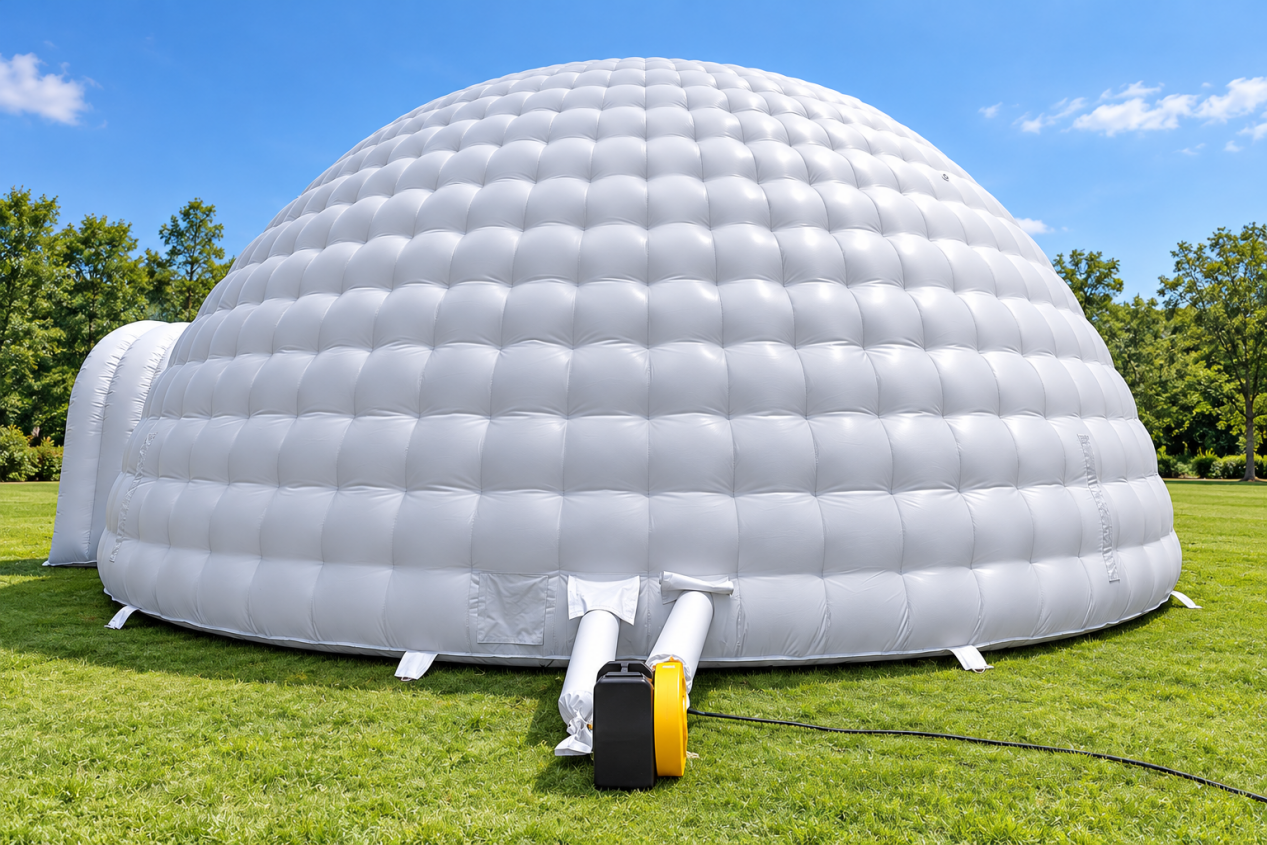
Sewn, air-supported tents and single-skin bubble domes generally require a blower to run continuously during use because their construction allows air to escape gradually. Without a continuous airflow supply, internal pressure decreases and the structure may lose its intended shape and rigidity.

This requirement is particularly important for outdoor exhibitions, promotional events, temporary retail spaces, and other applications where the tent needs to remain inflated throughout the activity. The blower must stay operational from setup until the tent is taken down.

For Joy Inflatable tents, the blower size and quantity are specified according to the individual tent design. Factors such as the structure’s internal volume and expected ambient conditions may also affect the equipment requirements. When requesting a quotation, please share your preferred tent dimensions and intended application so we can confirm the appropriate blower configuration for your project.
16
What is the difference between an air pump and a blower?

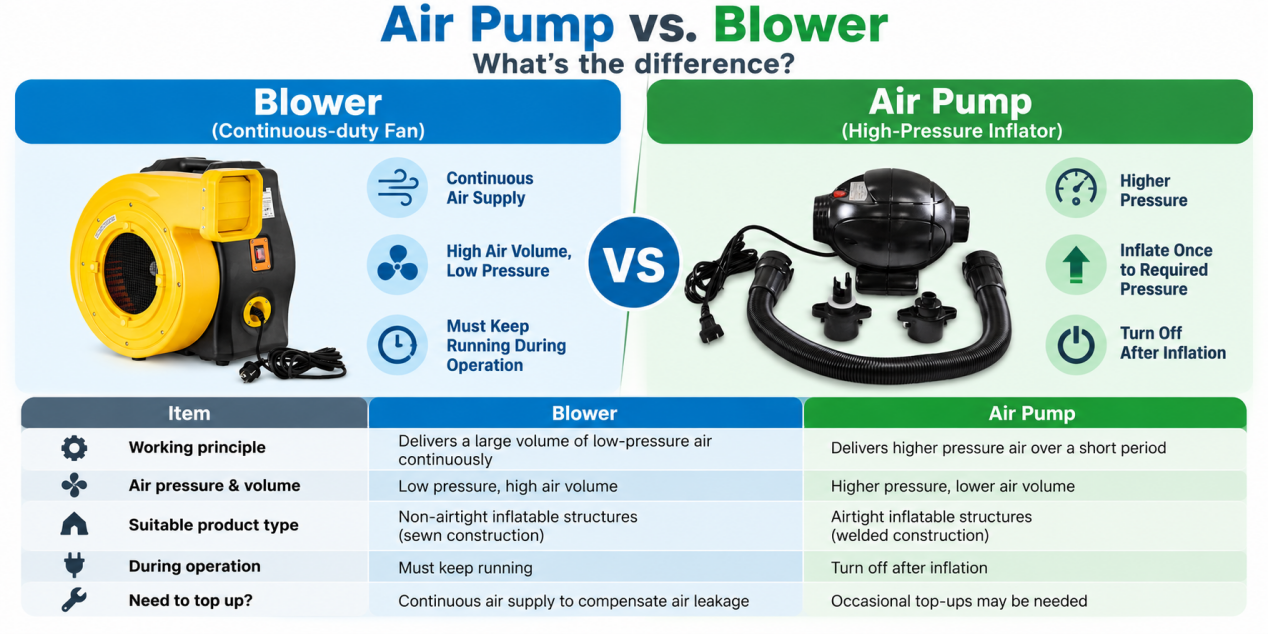
A blower is a continuous-duty fan designed to deliver a large volume of low-pressure air, compensating for air leakage in non-airtight structures. An air pump, also known as a high-pressure inflator, delivers higher pressure over a shorter period to fill sealed chambers to the required internal pressure before being disconnected.

For Joy Inflatable tents, the distinction depends on the construction type. Sewn, non-airtight tents use blowers that must remain running during operation to maintain inflation. Welded, airtight tents use pumps for initial inflation and may require occasional top-ups depending on usage conditions. These devices serve different purposes and are not interchangeable, so selecting the correct equipment for the tent design is essential for proper operation.
17
What inflation systems are used for inflatable tents?

Joy Inflatable offers two main inflation systems for its inflatable tents, depending on the construction: continuous-airflow systems for sewn, non-airtight tents and electric pumps for airtight beam tents.

Sewn air-supported tents use electric blowers to maintain continuous airflow throughout operation. Airtight beam tents, by contrast, are inflated with an electric pump and sealed after reaching the required pressure. Their airtight construction allows them to retain air without requiring a blower to run continuously.

When choosing between these systems, consider the tent’s intended application, operating duration, and access to a suitable power supply. A continuous-airflow system requires the blower to remain operational during use, while an airtight system does not need continuous airflow once inflation is complete.

The appropriate system depends on the selected tent model and project requirements. Contact Joy Inflatable with your intended application and preferred design to confirm the compatible inflation equipment and specifications.


For the great majority of custom inflatable tent projects the minimum order quantity is one piece. This policy makes single-unit custom manufacture fully accessible to clients who need only one tent for a specific event or location.

When multiple identical units or repeat orders are placed, the unit price may become more competitive because of production efficiencies. When requesting a quote, please specify the tent model, required quantity, and any customization details, such as size, material, colour, or logo printing. This information allows Joy Inflatable to assess your requirements and provide a quotation based on the proposed order.

Yes. Joy Inflatable offers customization options for inflatable tent structures, depending on the selected model and design requirements. Available features may include removable floors, clear PVC or TPU panels, raised edges, connecting tunnels, wide doors, specially shaped entrances, and connection sleeves. Transparent panels can be incorporated into suitable designs to provide visibility, while different entrance configurations and connecting sections can be considered according to the intended application.

The availability and configuration of these features depend on the tent's structural design and project specifications. When requesting a custom tent, please outline your preferred layout and required features so that their suitability can be assessed for the selected model. Specific materials, dimensions, and connection details should be confirmed during the design stage before production begins.
Yes. Joy Inflatable offers customization of tent colors, printed graphics, logos, and overall appearance according to project requirements. Clients can provide colour references, brand assets, and design ideas to communicate their preferred visual style, whether they want the tent colors to closely follow their corporate branding or prefer a broader event theme.

The design team can prepare a 3D drawing for review and production confirmation. Clients should check the proposed colors, graphics, and overall layout before confirming the design for manufacturing. Any specific brand colour requirements or printed details should be communicated in advance so their feasibility can be reviewed for the selected tent model and printing method.

Yes. A wide range of functional openings and panels can be incorporated into the tent design to suit different project requirements. Options include zippered entrances of various widths, removable sidewalls, clear viewing windows, mesh ventilation panels, HVAC connection sleeves, cable entry ports, and internal partitions. The availability and arrangement of these features depend on the selected tent design and intended application.

Understanding how people and equipment will move through the tent helps determine the most practical layout. During the design stage, clients should communicate their expected traffic flow, equipment placement, access requirements, and environmental-control needs. This information helps ensure that openings and panels are appropriately sized and positioned for their intended functions, making the finished tent layout more practical and efficient.

The printing method is selected according to the material and artwork, with options like digital printing or other suitable commercial printing processes. Digital printing may be suitable for detailed, multi-colour graphics, while other methods may be more appropriate depending on the material and design requirements. The choice of printing process depends on the characteristics of the base material, the complexity of the artwork, and the intended graphic presentation. Before manufacturing begins, we will confirm the artwork position, colour specifications, and print area in the production drawing. This ensures that the agreed printing details are clearly documented and reviewed before production starts. The final method and printing arrangement will be determined according to the specific tent model, material, and artwork requirements.

Yes. Joy Inflatable offers customized branding for inflatable tents, including logo printing, website addresses, sponsor graphics, and full-color artwork. Depending on the product design and material, printing can be completed using digital printing or silk-screen printing. Customers can customize colors, graphics, and printed areas to suit their brand identity, promotional campaigns, exhibitions, sporting events, or sponsorship activities.

To prepare your design for production, please provide high-resolution artwork, preferably in an editable AI, PDF, or EPS format. You can also share reference images and indicate your preferred logo placement, colors, and printing areas. These details help clarify the design requirements before production. The available printing methods and printable areas depend on the selected tent model and its construction. Please confirm your requirements with Joy Inflatable before placing an order to ensure the proposed branding is suitable for your project.

Yes. We can customize dimensions, overall shape, tube layout, colors and many functional details. Final feasibility depends on structural requirements, production methods and the intended application.

Dimensions are set according to site constraints and required internal volume. Overall shape may follow standard geometric forms or be developed as a purpose-designed outline. Tube layout is arranged to deliver adequate structural support while preserving usable space. Colors are selected to match project specifications or supplied references, and functional details such as entrances, windows or partitions are added where they improve practicality.

Each combination is reviewed against engineering limits and manufacturing capabilities to ensure the finished tent remains safe and suitable for its planned use.

Yes. Depending on the structural design, Joy Inflatable can incorporate HVAC connection sleeves, cable entry ports, dedicated lighting openings, additional ventilation panels, and internal partitions. These features allow clients to integrate climate-control or lighting equipment supplied by third parties and adapt the tent layout to their project requirements.

Please note that the tent structure itself does not include air-conditioning units, heaters, or lighting fixtures unless these items are specifically listed and quoted as part of the package. To ensure the required features are incorporated correctly, clients should communicate their equipment requirements during the design stage. Details such as equipment placement, cable routing, ventilation needs, and the intended use of internal partitions can help determine the appropriate positions and configurations of openings and sleeves.

Site dimensions establish the maximum footprint and height that can be installed safely while still leaving adequate clearance for access and emergency routes. Expected capacity determines the necessary internal volume, entrance widths and circulation space so that users can move comfortably. Local climate influences the choice of material grade, the strength of the anchoring system, the number and placement of ventilation openings, and the geometry of the roof.

When these three factors are considered together, the resulting design physically fits the location, accommodates the intended number of people or equipment, and performs reliably under the prevailing weather conditions.

Development of a custom tent follows a clear, collaborative sequence. We begin by reviewing the stated application and the physical conditions of the site. On the basis of that information we recommend an appropriate structure and material combination. A technical drawing or free 3D proposal is then prepared and submitted for client confirmation.

Once dimensions, functional features and visual appearance have been approved and the commercial terms settled, production proceeds strictly according to the agreed specification. The process concludes with final quality inspection, packing and shipment, ensuring the delivered tent matches the approved design in every material respect.

A complete and accurate brief is the foundation of a successful custom project. Please provide the intended use scenario, any preferred design references or photographs, the required external and internal dimensions, expected guest or equipment capacity, site photographs or layout drawings, typical weather conditions at the location, logo or artwork files in editable format, the delivery destination, and the target delivery date.

If some information is not yet available, you can start with your initial concept, reference images, and estimated dimensions. Joy Inflatable can review the information provided and clarify any missing details before preparing a proposal and quotation.

Reliable power planning is essential for any inflatable installation. Before the event, the local voltage and frequency, the number and load capacity of available outlets, the circuit rating, cable length and routing, and the presence of residual-current protection must all be verified. For continuous-air tents the blower must never be starved of electricity or blocked at the air intake and exhaust.

We recommend confirming these details on site in advance. Suitable protection devices should be installed and the blower’s ventilation paths kept completely clear throughout operation. Clear planning of the power supply prevents unexpected interruptions, overheating or loss of inflation during the event and contributes directly to safe, uninterrupted performance.

Selecting the correct inflation system begins with the tent’s construction method, overall volume, material thickness, required setup speed, available electrical supply and any noise restrictions on site. Continuous-air (sewn) tents need a blower sized to replace air lost through fabric and seams, while airtight tents need a pump capable of reaching the design pressure efficiently and then being removed.

We evaluate these parameters together with the local voltage and frequency. Once the details are clear we specify compatible equipment—whether a continuous-duty blower or a high-pressure pump, so the system operates safely, quietly and efficiently in the intended location. Providing accurate site power information at the quotation stage ensures the delivered equipment matches local conditions from the first use.

Only structures built with fully sealed, high-frequency welded airtight chambers are able to maintain their shape after the inflation device is removed. Once the valves are closed, internal pressure is retained by the integrity of the welded seams and the PVC material itself.

At Joy Inflatable, tents constructed with welded airtight PVC beams operate on this principle. After the electric pump has brought the tubes to the design pressure and the valves have been sealed, the blower or pump can be disconnected. Temperature fluctuations may still cause minor pressure variation, so periodic visual checks are recommended during long deployments or when ambient conditions change significantly. This sealed-beam design is particularly useful for sites where continuous power is limited or where blower noise must be avoided.

Sewn, air-supported tents and single-skin bubble domes generally require a blower to run continuously during use because their construction allows air to escape gradually. Without a continuous airflow supply, internal pressure decreases and the structure may lose its intended shape and rigidity.

This requirement is particularly important for outdoor exhibitions, promotional events, temporary retail spaces, and other applications where the tent needs to remain inflated throughout the activity. The blower must stay operational from setup until the tent is taken down.

For Joy Inflatable tents, the blower size and quantity are specified according to the individual tent design. Factors such as the structure’s internal volume and expected ambient conditions may also affect the equipment requirements. When requesting a quotation, please share your preferred tent dimensions and intended application so we can confirm the appropriate blower configuration for your project.

A blower is a continuous-duty fan designed to deliver a large volume of low-pressure air, compensating for air leakage in non-airtight structures. An air pump, also known as a high-pressure inflator, delivers higher pressure over a shorter period to fill sealed chambers to the required internal pressure before being disconnected.

For Joy Inflatable tents, the distinction depends on the construction type. Sewn, non-airtight tents use blowers that must remain running during operation to maintain inflation. Welded, airtight tents use pumps for initial inflation and may require occasional top-ups depending on usage conditions. These devices serve different purposes and are not interchangeable, so selecting the correct equipment for the tent design is essential for proper operation.

Joy Inflatable offers two main inflation systems for its inflatable tents, depending on the construction: continuous-airflow systems for sewn, non-airtight tents and electric pumps for airtight beam tents.

Sewn air-supported tents use electric blowers to maintain continuous airflow throughout operation. Airtight beam tents, by contrast, are inflated with an electric pump and sealed after reaching the required pressure. Their airtight construction allows them to retain air without requiring a blower to run continuously.

When choosing between these systems, consider the tent’s intended application, operating duration, and access to a suitable power supply. A continuous-airflow system requires the blower to remain operational during use, while an airtight system does not need continuous airflow once inflation is complete.

The appropriate system depends on the selected tent model and project requirements. Contact Joy Inflatable with your intended application and preferred design to confirm the compatible inflation equipment and specifications.
INFO CENTER
Guangzhou JOY Inflatable Limited
Add.: No.99 GaoZeng Street, RenHe Town, BaiYun District, Guangzhou city,Guangdong province,China.
Mobile: 0086-13580461845
Copyright © 2026 Joy Inflatable  | Sitemap  Privacy Policy
Contact us
whatsapp
Contact customer service
Contact us
whatsapp
cancel
Customer service